

Snowflake unveils Postgres to make enterprise data AI-ready
Tue, 3rd Feb 2026.webp)
Snowflake has unveiled Snowflake Postgres alongside a suite of data governance, sharing, and resilience updates. These enhancements are designed to make enterprise data "AI-ready" as organisations increasingly move artificial intelligence into production systems.
The company confirmed that Snowflake Postgres will run natively within its AI Data Cloud and is set for general availability shortly. Snowflake has positioned the release as a strategic move for customers looking to consolidate transactional workloads, analytics, and AI development into a single, unified environment.
"As businesses move from AI experimentation to production, the real challenge is ensuring AI systems can consistently access data that is connected, governed, and discoverable across the enterprise," said Christian Kleinerman, EVP of Product, Snowflake.
Snowflake said many organisations still separate transactional databases from analytical systems. It said that separation leads to complex data pipelines and higher costs, and it adds operational risk.
Postgres Push
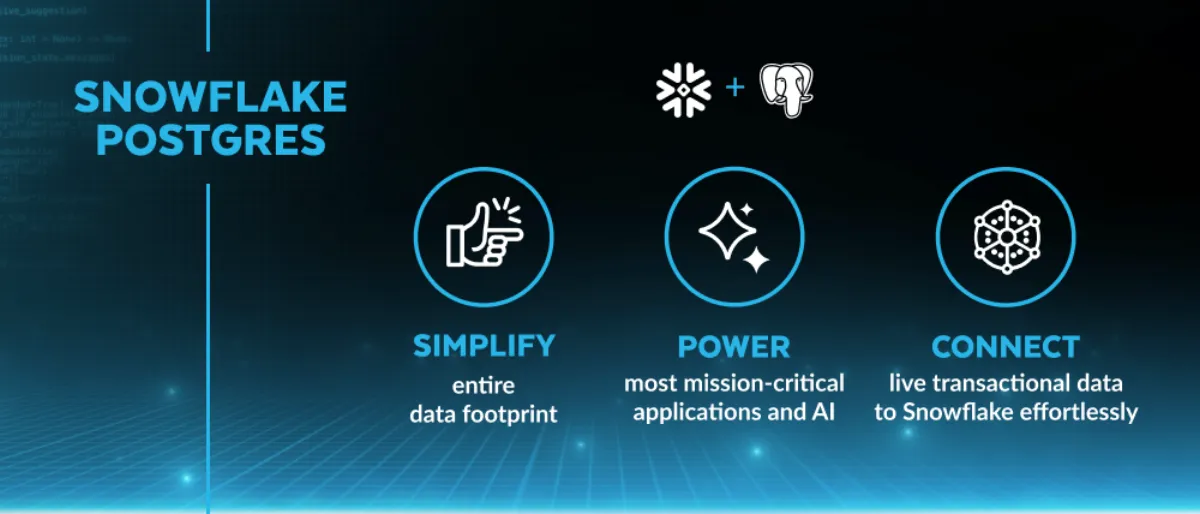
Snowflake Postgres aims to bring Postgres-style transactional work alongside analytics and AI. Snowflake said it will support full compatibility with open source Postgres. It said customers can move existing applications onto Snowflake without code changes.
Snowflake said Snowflake Postgres will integrate with Apache Iceberg through pg_lake, which it described as a set of PostgreSQL extensions. Snowflake said customers will be able to query, manage and write to Iceberg tables using standard SQL from a Postgres environment.
The company said this approach reduces data movement between transactional systems and analytical systems. It said customers can keep data in open table formats while using Snowflake for database operations and analytics.
Snowflake named BlueCloud and Sigma Computing as users of Snowflake Postgres. It said the product fits use cases that combine operational applications, analytics and AI models or agents that depend on current operational data.
Sigma Computing described the product as a route to working directly with transactional data inside Snowflake.
"At Sigma, our customers expect live, interactive analytics on the most current business data," said Jake Hannan, Head of Data, Sigma Computing. "With Snowflake Postgres, we can work directly on fresh transactional data inside Snowflake without relying on complex pipelines or external systems. That gives our teams and customers a simpler, more reliable foundation to build governed analytics and AI-powered experiences that respond in real time."
BlueCloud pointed to financial services workloads and to combining low-latency transactions with analytics.
"For BlueCloud, Snowflake Postgres represents a major opportunity to help our customers eliminate data pipelines, without compromising performance," said Rob Sandberg, SVP and Head of Advisory Consulting, BlueCloud. "Its enterprise-grade Postgres foundation brings real credibility, particularly for the financial services organizations we support. With Snowflake Postgres, we can deliver low-latency transactional workloads alongside analytics and AI on a single platform, reducing overhead and helping our customers be more agile in meeting their business goals."
Catalog Controls
Alongside Snowflake Postgres, Snowflake detailed product updates focused on data interoperability and governance. The company said AI deployments require data that remains governed and resilient as it moves across systems and formats.
Snowflake said it has expanded enforcement of governance policies when Snowflake data is queried from other engines. It said this work is tied to Snowflake Horizon Catalog, which it described as providing context and governance for AI across data.
Snowflake said Horizon Catalog will allow customers to use external engines to access data in Apache Iceberg tables, and that support is generally available. It also said customers will be able to create, update or manage data stored in Iceberg tables, and that work is in public preview.
Snowflake identified Merck and Motorq as customers using Horizon Catalog for access and governance across different systems and formats. The company linked the product to efforts to reduce data silos and address lock-in concerns.
Open Sharing
Snowflake also announced Open Format Data Sharing. It said it extends Snowflake's "zero-ETL sharing model" to open formats including Apache Iceberg and Delta Lake. Snowflake said the feature supports secure data sharing across teams, clouds and regions, while maintaining control over access and costs.
The company also said it has a generally available integration with Microsoft OneLake. It said mutual customers will get secured bidirectional read access for Iceberg data managed by Snowflake or Microsoft Fabric. Snowflake said the integration avoids data duplication and reduces complexity for customers with deployments across both platforms.
Backup Option
Snowflake said it has made Snowflake Backups generally available. It described the feature as a measure for protecting business-critical data and meeting regulatory requirements. Snowflake also said it would support faster recovery after ransomware and disruption events. It said the design prevents data from being altered or deleted once created.
Snowflake said the set of updates reflects a broader push to embed interoperability, governance and resilience more deeply into its platform, and to allow customers to bring Snowflake to data held in different places.