


Global robotaxi market set for rapid growth by 2033
Tue, 7th Jul 2026.webp)
Persistence Market Research projects the global robotaxi market will reach USD $153.4 billion by 2033, up from an estimated USD $8.3 billion in 2026.
The forecast signals rapid growth in a sector that remains fragmented, with no single company controlling autonomous ride-hailing. Competition is spread across technology groups, carmakers, mobility operators and specialist developers of self-driving systems.
That sets robotaxis apart from more established parts of the automotive market, where a smaller group of manufacturers often dominates output. In autonomous mobility, companies are competing across multiple layers at once, including software, vehicle design, sensors, mapping, fleet management and customer-facing services.
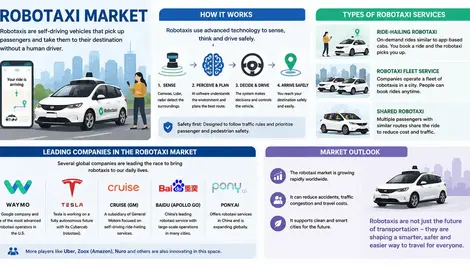
Competitive field
The report identified Waymo as one of the clearest leaders in commercial deployment, citing its fully driverless ride services in real-world passenger settings. That matters because each journey generates driving data that can be used to improve machine learning models, navigation systems and safety performance.
As more driverless miles are logged, companies can refine how their vehicles handle congested roads, junctions and other difficult traffic situations. This has helped make Waymo a benchmark operator, even as rivals pursue different technical approaches.
Tesla remains one of the most closely watched companies in that debate because it relies on camera-based vision systems backed by neural networks and artificial intelligence, rather than making heavy use of LiDAR. That choice has become a dividing line in the industry over cost, scalability and how much sensor diversity is needed for fully autonomous operation.
Supporters of Tesla's approach argue that vision-led systems could be cheaper to deploy across large fleets. Critics, however, question whether cameras alone can consistently provide the same level of environmental awareness as a broader mix of sensing tools.
Cost pressure
The economics of robotaxi services are emerging as a central issue for the sector. Early autonomous vehicle prototypes often depended on costly sensor arrays and computing hardware, making commercial operation difficult to justify beyond test programmes.
Attention has shifted to cutting hardware costs without undermining safety or performance. Companies including Pony.ai, WeRide and XPeng are trying to simplify hardware design and improve manufacturing efficiency as they move from experimental fleets toward broader commercial services.
That effort reflects a basic challenge for the industry: robotaxi operators will need to offer fares that match or undercut conventional ride-hailing services to achieve broad adoption. Technical progress alone is unlikely to be enough if the business model remains too expensive.
Partnership model
Partnerships are becoming a defining feature of the market because few companies can cover every part of the value chain alone. Carmakers provide vehicle platforms, software groups build autonomous systems, chipmakers supply computing hardware, and transport operators manage app-based booking and passenger services.
These arrangements let companies specialise while reducing development time. They also spread risk in a sector where testing, validation and deployment remain expensive and operationally complex.
The need for collaboration helps explain why the market is difficult to "own" in any traditional sense. Leadership is shaped less by outright control than by a company's ability to combine technology, regulatory access, fleet operations and commercial discipline.
Regulatory hurdle
Regulation remains one of the biggest constraints on expansion. Before launching commercial driverless services, companies must satisfy governments and transport authorities on testing, safety standards and oversight.
That means market leadership can depend as much on regulatory relationships and evidence of safe performance as on the sophistication of the underlying software. Operators that secure approvals in more cities and regions are likely to gain an advantage in data collection, brand recognition and route density.
Consumer sentiment is another important variable. Public familiarity with driver-assistance systems, electric vehicles and artificial intelligence has grown, helping build trust in autonomous transport, although broad acceptance still depends on consistent safety records in day-to-day use.
Persistence Market Research argued that robotaxis could eventually improve transport access for older people, lower travel costs and support more efficient urban mobility networks. Even so, the sector's leading companies still need to prove that autonomous ride services can work safely, reliably and profitably outside limited operating areas.
The result is an industry in which leadership remains fluid. While a small group of companies has built early advantages through technology development, pilot programmes and initial commercial deployments, the balance could still shift as costs fall, rules evolve and new entrants expand their reach.
Even with that uncertainty, the researcher forecasts strong growth, with the global robotaxi market expected to expand at a compound annual growth rate of 51.7% between 2026 and 2033.